
Group Facilitation
Group time is hugely valuable, but is too often wasted. It takes effort and planning to get a group of people together for an hour, and the number of human hours being used in that gathering is high. We might as well make it worthwhile, and ensure that the time and energy required for it is returned with interest.
Whether that is true, or whether we leave feeling like our time would have been better spent elsewhere, tends to have a lot to do with the quality of the facilitation.
Having a trained facilitator who can hold the space for everyone, and channel the conversation towards collective agreements, is a vital way to protect and enhance the value that you’re putting into your collective project by all showing up. It becomes even more important when there are some emotions in play, and the cost of not managing the gathering well is even higher.
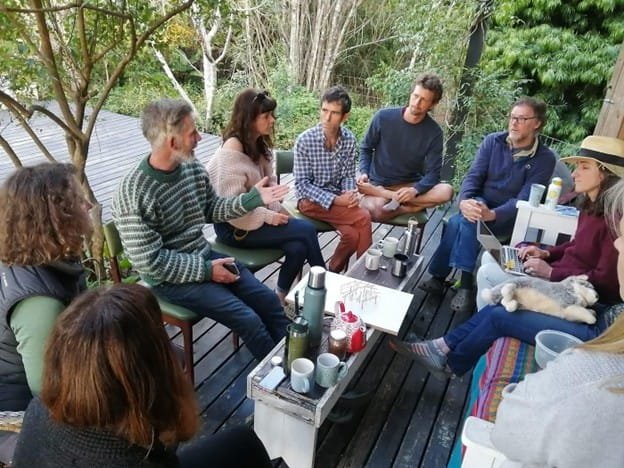
Running effective meetings, and facilitating discussions that can be both productive and heart-based, has become a passion for me – be it for NPOs, businesses, intentional communities or small groups.
What’s Possible?
The more time I spend observing groups, working in them and facilitating them, the more I see the different levels in this work. What follows is my ‘point of view’ about skilled facilitation.
Currently there are four ‘facets’ of facilitation that feel most relevant, the last of which emerged from some experiences that I had with facilitating groups.
Sometimes meetings will require facilitation mainly from one of the levels. This is usually the case with a newish group, or one who is going through a period of heavy chafing, when they will largely need the first facet.
Usually a meeting will involve several or even all of the different facets, and a facilitator in top form can perform the fourth one even when the meeting is largely requiring the first.
I originally came across the phrase ‘Magician, Cheerleader, Sheepdog’ outside of facilitation circles but thought it applied perfectly to what I’m trying to do when I’m asked to facilitate group meetings. I’ve since re-ordered them and added the fourth piece.
The first one could be seen as the lowest level, and the last one the highest, but they are all equally important.
1. The Sheepdog
Peoples’ time is valuable, so when we’re meeting in groups, it’s vital that the conversation is kept on course. Without a facilitator who can monitor this and keep everyone on track, some members will get bored or start to resent the fact that someone has headed down an irrelevant rabbit hole again.
The facilitator needs to round up the stray conversations and continue to move everyone in the right direction.
This can be tiring, and as I mentioned before, it’s not uncommon for groups who are new or who are experiencing some sense of conflict to need a persistent sheepdog.
But it’s essential work, because ultimately this is what sets the boundaries within the group’s meeting culture.
Once they are set, the group qualifies for the next levels of conversation, which is where the real rewards of group work become possible.
2. The Cheerleader
Let’s be honest, meetings can take a toll on our energy levels.
Sometimes a group can be making excellent progress on a topic, but because there has already been an hour of in-depth conversation, participants are too tired to actually see that progress.
When a facilitator can remind them about what has been accomplished — and do so with a celebratory flourish — it can light the fire for everyone again.
This helps to keep any potential drudgery at bay, and allows the conversation to reach completion with a sense of joy.
3. The Magician
As a group matures, it needs less of the sheepdog because members are better at sticking to the point. This frees up more energy from the facilitator to cheerlead.
But that also becomes less necessary over time, because the energy saved from not veering off topic means that the work flows quicker. Less cheerleading is needed.
From here the pace can drop a little, and a space opens up. This is where the magic can happen.
What magic?
For me, the magic is when the group ends up with ideas, solutions and decisions that are beyond what it thought possible when the meeting started.
This should be a common occurrence in groups, because combining a diverse set of people with their various experiences, skills, knowledge and ways of thinking is bound to generate something that is beyond what a bunch of separate individuals could see beforehand.
Yet anyone who has worked in a group before knows that this is not necessarily the case, because tied up within the group will be a variety of different personalities that may not gel easily.
When a facilitator is channeling the magician, they are keeping the space open enough to draw on the diversity at hand. This involves making sure that nobody is left behind, and nobody is allowed to dominate and detract from others’ participation.
Sometimes creating the space for this means just staying out of the way and letting the group flow through a conversation.
But it also involves asking the right questions at the right time, to keep the group available to all possible options — including ones that are yet to be discovered.
4. Steward of the Collective Unconscious
Meetings can be intense, and fast-paced. Sometimes they need to be, and that’s okay. As the facilitator, it can be easy to get swept up by the swell of energy, and that’s okay too.
Increasingly what I am noticing is that when I can slow down within myself, a different type of listening can occur that makes it possible to read between the lines of what is being said, and see what is left unsaid.
I see this as the group’s collective unconscious, and it holds the issues that are moving the group in ways that it cannot currently see, or is unwilling to address. Sometimes it is like an elephant in the room; sometimes it is more subtle to the point of being felt on an energetic level. Whatever form it is taking, it holds the key to the group’s growth.
Bringing it to the group’s awareness can be scary and unsettling. Most of the time it has been (unconsciously) left out of the conversation because people are afraid of ‘waking the dragon’ and stirring a conflict.
Yet raising it is the greatest service that the facilitator can do for the group. Addressing it is going to remove a blockage that was previously holding the group back, allowing it to transform towards something greater.