
Conflict Resolution Facilitator | Tristan Holme
Working With Conflict
I see conflict differently to most people.
While society has taught us to view it as problematic, and something to avoid or work past, I see conflict as opportunity. Opportunity to better understand ourselves, to work through and shift the frightened parts of our personalities, and to connect to each other through vulnerable exchanges.
Conflict can be scary, and like most people I’ve avoided it many times in my own past – always to my own (and others’) detriment. It took time and training to embrace it for the gift that it can be if we utilise it effectively.
To do so requires a deeper understanding of the different types of conflict, as well as tools and processes to alchemise it.
This is what I offer in my workshop ‘Getting Comfortable With Conflict’, and when I facilitate conflict work with couples, families, groups, businesses and communities.
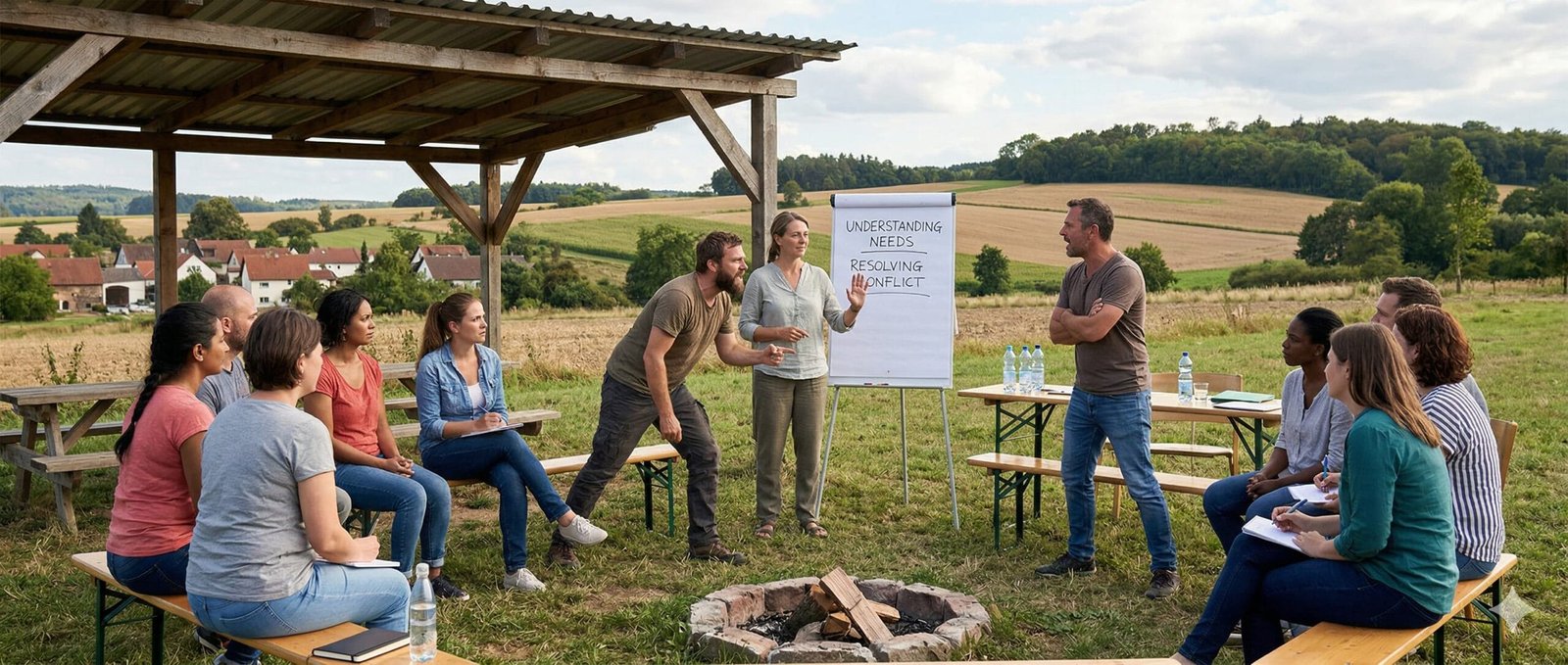
I don’t offer mediation per se – I am not trained as a ‘mediator’ – but I do offer a process to help people work through the blockages that are taking a toll on their emotional, relational and even financial wellbeing. Sometimes the sustainability of a multi-year project depends on the removal of those blockages.
The Hidden Costs of Ongoing Conflict
It’s natural and healthy for us to have differences as humans. How it gets expressed, or whether it gets suppressed, is where the difficulty comes in.
When we are free to express our unique perspectives in a held space, it leads to connection rather than tearing us apart. When we feel safe enough to be vulnerable and bring what we’re holding in our heart, magic can happen. This is true whether we are addressing an underlying conflict, or just facilitating conversations towards social regeneration.
Of course, when this doesn’t happen then conflict can be destructive in a number of ways – particularly in a group space.
The difference in outcomes was highlighted by an experience I had a few years ago, when I facilitated an AGM for a community with a history of conflict. (click to read this event)
Whilst the effects of that conflict had dissipated as a key legal agreement was put in place and Covid brought in a fresh wave of eager communitarians, the root cause of it in the most affected participants had not been fully dealt with — in part because they had not been living in the community and had missed previous meetings. The knowledge that one such member was going to be present at the AGM brought an air of tension and anticipation among many members. The sense of an impending showdown was present.
Lo and behold, the showdown moment came to pass during the meeting. And just as the irate member was getting wound up, another participant tried to change the subject – probably because of growing discomfort or fear about what might be coming. This did nothing to ease the rising tension in the room.
So I brought the conversation back to the irate member, and reflected back to him some of what I had heard him say. I acknowledged that he had said quite openly that he was wanting to move past this, and I asked him what could help him do that. His resulting request was actually quite simple, and was something that everyone could get on board with. Having been heard, he became a positive participant in the meeting thereafter. But the benefits to addressing the underlying conflict were much broader, as became clear afterwards.
Two days after the meeting, I received a call from one of the participants. “I just wanted to thank you for the way that you held space in the meeting, because that could have been a shit-show,” he said. As someone who was fairly new to the community and fresh to the potential dynamics of a plenary meeting, he spoke about the fears that came up as the conflict inevitably reared its head, and the relief he felt as it was worked through. “I just felt so safe,” he said.
He was not the only one to give this kind of feedback. Even the member who had been carrying the conflict came up afterwards to give his appreciation, which extended to the trustees who were doing the work that he had held concerns about.
While this was obviously gratifying, my satisfaction had little to do with ‘resolving a conflict’, and more to do with observing the ripple effects that can come from working a conflict in the dynamic moment in a big group.
“Tristan Holme is a marvel at this, I have been in a very intense AGM situation where he masterfully caught a conflict fireball and sent it down a path of peaceful conciliation. I am eternally relieved, grateful and definitely wise enough now to find support from someone who can coax a peaceful diversity from a yawning polarity. For anyone looking to venture into the highly valuable field of community building, I wholeheartedly recommend the investment.”
The Underlying Potential
This idea of conflict representing potential is different to a lot of the conditioning that we have around conflict, which is seen as this ugly thing that should be kept out of public space and dealt with quietly in the background where nobody has to see or experience it.
Of course there is a place for working through differences in private, but when a conflict has already come into a group setting, its energy will be in that space whether we like it or not. If it is subsequently resolved behind closed doors, that might bring some relief for the group, but a sense of fear will likely linger: what happens next time? And let’s face it, there will always be a next time.
At best this fear will affect the ability of all participants to contribute fully to the conversation (expression becomes dimmed). At worst — and this is common — they will be treading very cautiously with their words, actions and ideas in case they wake the dragon.
Much of this comes from societal conditioning. Many of us were raised in environments where emotions were not acknowledged or allowed, let alone welcomed. This has bled into how we operate in groups, where we place a high value on intellectual output in meetings, and anything remotely emotional is frowned upon, cast aside, and in some cases shamed. The message we usually carry? ‘We shouldn’t let emotions get in the way of business.’
Yet if we work conflict in front of the whole group, and we help a member who is in distress to de-escalate and return to a state of presence, the group leaves with an entirely different message. Ideally it is something like: ‘We can allow differences to come up, and sometimes that will trigger certain members in our group, but we have the capacity to hold space for that and work through it.’
When this happens consistently, the process becomes less reliant on the facilitator to hold that space, because the group is becoming emotionally mature. And when their participation is not being distorted by a lingering fear, everyone is able to contribute effectively and the group can make better decisions.
It’s worth mentioning that this isn’t just applicable to groups. As my incredible instructor at the Foundation for Intentional Community, Laird Schaub, said: ‘When is this stuff relevant? Only all of the time! I’m just teaching you how to work with it in the most complex and challenging environment, which is intentional community.’
Like most people, I grew up conflict averse and took a long time to learn how to work through it in my close relationships. And early on in my intentional community journey, I realised that most of our group — myself included — was not only averse to conflict, but was also unwilling to reach out to find support when it arose.
I see now how having a neutral facilitator who can guide the group through those choppy moments can be a great investment in their future health.
A Short Questionnaire
Considering whether to engage a facilitator to help resolve a conflict?
Here are six questions that you can mull over. This will help you to assess the level of conflict that you’re facing, and should you wish to engage with me, it will help me to understand the situation better.
If you do reach out for a Good Fit Call, please share your answers in the section provided when booking the call.
- Are members of your family/group/business/community on speaking terms? How bad is the conflict?
- What are some of the disagreements that have come up?
- What is the cost of not resolving the issue?
- What’s motivating you to address it?
- What have been the barriers to finding agreement on critical issues?
- Do you have a conflict transformation tool/practice in place?
- What are you willing to invest (time, money, and energy) to resolve your issues?