Intentional Community Consultant | Ecovillage Design
Intentional Communities
Creating and maintaining an intentional community is a hugely complex and ambitious project. Research has suggested that 9 out of 10 communities fail to get off the ground. Even when they do make it, it’s inevitable that they will go through periods of difficulty and confusion, often because of a natural transition that is taking place.
Yet it’s not surprising that, despite the challenges, there has been a surge of interest in community living in recent times. More people are realising that community can be a more supportive environment to live in than the nucleated setup to which we have become accustomed. The experience of building something effectively together and raising our overall quality of life can be hugely rewarding.
It takes a great number of things to do this well though.
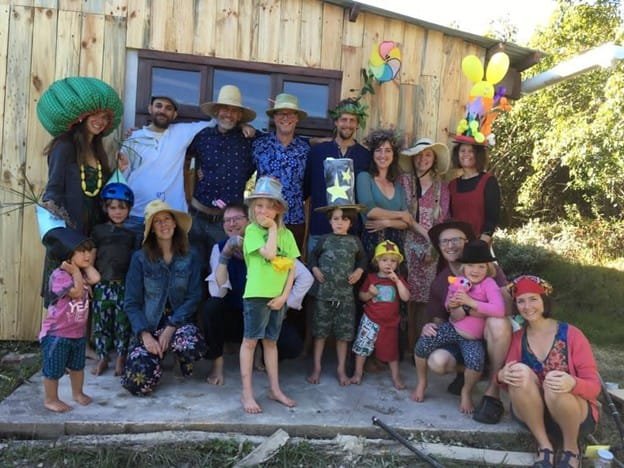
Given the scale of the task, it’s ironic that very few communities reach out for external help until they are in crisis mode. I understand how this can happen because I’ve been there myself. What I’ve come to realise is that whether we are just starting out, or we’re an established community going through a challenging period, we need a little outside help from time to time.
For some insight into some of my own experiences in this field, and how I came to consult to other communities, scroll down for an interview that someone conducted with me a few years back.
My core interests and offerings in this field lie in values discernment, governance structures, collective decision making, community facilitation, and conflict work.
These pieces are all inextricably linked under the banner of ‘invisible structures’, and assisting a community will usually require a combination of these skills and tools.
At the heart of my work is Values-Based Decision-Making. Any experienced community consultant will tell you that everything in your community should come out of your values, whether it’s your legal structure, your governance framework, how you evaluate different land options, and even your land design.
VBDM is the most comprehensive tool that I have come across in the communities movement, because it goes so much further than the upbeat (but often meaningless) mission statement that most communities start out with. Not only does it give a group clarity around its shared values and desired future, it offers a system for how to get there, one step at a time.
For an in-depth explanation of how VBDM works, and the benefits it offers to intentional communities, you can watch the presentation that I gave to the Foundation for Intentional Communities below.
Some of the situations that I can assist with are:
For New Communities
Individuals or Families considering Community Living
- Individuals or families who are interested in community but need to decide whether living in community would be right for them.
- Or they are clear that community is what they want, but feel overwhelmed by how to decide which community would suit them.
New Communities Ready to Launch
- New communities that are ready to seek land or to launch their project but need clarification on what they should be looking for.
- If your land search is taking time to the point where members are losing interest and belief in the project, there is likely some underlying work to be done.
Communities in the Forming Stage
- Looking for someone with experience, tools and processes to guide you through visioning and decision-making.
- By learning how to use VBDM, you set yourselves up for the long haul of making good decisions collectively.
You are a Landowner Considering a Community
- You are a landowner who is considering creating a community on your piece of land, but wonder how the complexity of the ownership dynamic can be managed well.
- Examples of communities with unequal ownership structures going wrong are all too common, but they are possible with the right structures, processes and clear communication.
- Having neutral guidance can be a gamechanger.
For Established Communities
Seeking Neutral Assistance
- You may be wondering if everyone in the community is there for the same reason, or shares the same values.
- You may need an outside eye to pick through conflict that has arisen and help you all back into alignment.
- Most often there is a chink in your decision-making process (aka governance), and getting it ironed out can change the entire dynamic and allow you to move towards your collective potential.
Decision-Making
- Established communities who need help to make decisions more enjoyably and effectively.
- Meetings have either become fractious, or tedious.
- Or you may feel as though you are spinning your wheels with no forward progress, and you’re ready to save time and money by improving your decision-making.
Conflict Assistance
- A community who has a sticky topic that they need to work through with some neutral facilitation (link to facilitation page).
- Or who has a conflict (link to conflict page) that they need assistance navigating.
You wouldn’t take on the design of your electrical system without expertise, so I find it interesting how many people in communities assume that they can design their invisible structures despite having no experience and few – if any – related skills.
I see this happen in my own community quite often.
Getting the right guidance can unlock the true potential of your group, and allow your community to become the success story that changes the narrative of what’s possible in the intentional community space.
About Me & Community
Back in 2024, some dear friends at Heart & Soil Homestead featured me in their interview series on regenerative practice.
While plenty of life has happened since then and some things have shifted, my experience of community, and the philosophy and concepts expressed, continue to inform my work in the field.
Tell us a little about yourself!
I’m a 39-year-old father of two boys who became interested in permaculture and land design, and then found myself co-founding an intentional community and falling in love with social design, ecovillage design, life design and facilitation. I had the good fortune to grow up in Zimbabwe in the 1990s. I’ve been in South Africa since finishing school, and moved to Kuthumba Ecovillage on the Garden Route at the beginning of 2020 as part of the community that we formed in Cape Town.
How did you start doing what you are doing now?
The short answer is that I had children. The slightly longer answer is that I had children at a time when I was questioning more and more about societal structures and cultures. My older son was just four months old when I came across the concept of Self-Directed Education (SDE — or sometimes called Unschooling), and eight months old when I did a Permaculture Design Course. Both gave me new ways of looking at the world.
I used the PDC to convert our quarter-acre property in Cape Town into an urban permaculture site, but as the boys got older, my partner and I realised that if we wanted to create a rich and supportive family environment for SDE, all roads led to some sort of residential intentional community. In 2019 we founded a small community of fellow SDE families in Cape Town, and created a vision that was based on a clear set of values. Through this we quite quickly realised that our original plan of creating a new ecovillage somewhere near Cape Town would not support those values, but buying land in Kuthumba would.
At the time, Kuthumba had fewer than 20 people living on more than 30 properties, but it clearly had the infrastructural bones to support the emergence of a flourishing community. We moved there as a group of four families, and now there are 10 families, plus plenty of couples and singles of various ages. In all there are over 50 people living here full time now, and it’s growing pretty quickly.
On a personal level, the process of forming a community helped me realise that while I love land design, it’s life design and community design that really makes me come alive.
What are you most proud of in this process?
The fact that we did it, and that all of the families who were part of the original community process are still here, and more join every year. We now have a fully-functioning self-directed learning centre that was founded two years ago and is community-run. It provides a space for our children to gather, engage and learn, and now has children from families outside of Kuthumba attending.
Unfortunately such stories are rare in the intentional community field — most people who have been involved in one in South Africa (and also further afield) have been burned one way or another, and generally have a perception that it’s either a bad idea, or isn’t possible. I would say that it’s an incredibly complex thing to do — you’re essentially starting a business and an intimate relationship with a whole group of people — and goes against so many of our ingrained cultural behaviours. So we’re in a process of learning how to do it well.
Because I enjoy that process so much, have learned a lot, and have had successes as well as failures, I now offer my services to people who are interested in creating community and doing it well. I love that there’s such a breadth of elements involved: forming and visioning, facilitation, conflict transformation, social design, land design, building, communication skills and many others. It’s like all of life is contained within the process of starting and maintaining an ecovillage.
What is the most helpful piece of advice you received when you were just starting out?
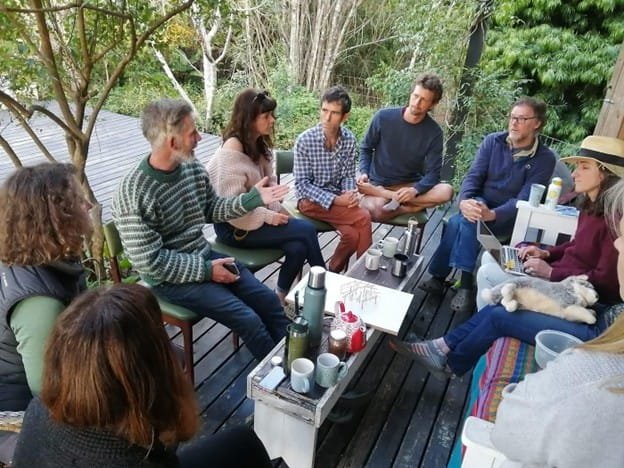
When I was living in Cape Town, I started an urban permaculture design business with a friend and mentor. At the outset, the mentor said, ‘The first thing we need to do is create a Holistic Context’. This was a set of values for the business through which we would make decisions. I had briefly learned the process in my PDC but not applied it since. Using it in the nascent stages of a business gave me insight into just how critical it is to identify shared values in any group setting, and know how to make decisions by them. It’s also essential for any land design, because while it’s great to do a permaculture design analysis on a site and come up with ideas, you won’t have a regenerative scenario unfolding without knowing who the people are and what they value.
When we formed the community, I used the Values Based Decision Making framework for our visioning process. It really worked, and has become the most valuable and effective tool in my toolbox, and the one that I recommend most. It’s also had a hugely positive impact in my own life — the more I make decisions according to my values, the better it becomes.
What advice would you like to give to others who are younger/earlier on their journey?
If you’re starting a residential community, the stakes are high. You’re putting your financial and emotional wellbeing into the hands of a group, so don’t do that lightly. Take time to get to know the other people in the group and understand whether your values are shared in areas that are important to you.
Secondly, exercise some humility. If you had never ridden a horse before, you wouldn’t go out and play a polo match without some training and coaching. Too many of us (and I include myself in this) have thrown ourselves into community making with the thought that we knew what we were doing, or would figure it out somehow. That was fine 30 years ago when the ecovillage movement was young, but we have three decades of experiences to lean on now, so reach out to people with that experience and knowledge to guide you. When the stakes are high, the falls are hard so it’s worth avoiding them if you can. Sure, we all learn from mistakes, but they don’t all have to be our own.
Also, be aware that creating a community or living in one will turbocharge your personal growth journey. I wasn’t expecting this to be part of the territory, and I think it’s useful to know it ahead of time so you can take steps to resource yourself and have the support in place that allows the growth to be nurtured and beneficial, rather than traumatic.
Is there anything else you’d like to share? Where do you see the communities movement going in South Africa?
It’s growing for sure. People are actually doing it — whether it’s an attempt to start something new, or join an existing ecovillage. There are probably only two or three ecovillages in South Africa (that I’m aware of) that have ridden the first wave of the movement that started in the 1990s and come out the other side, and they’re only now getting their shit together properly. I think if we can do that well and provide some successful models for others, the next wave is going to be strong and productive because people are recognising en masse that living in some sort of community, or even just creating it around them on some level, is vital.